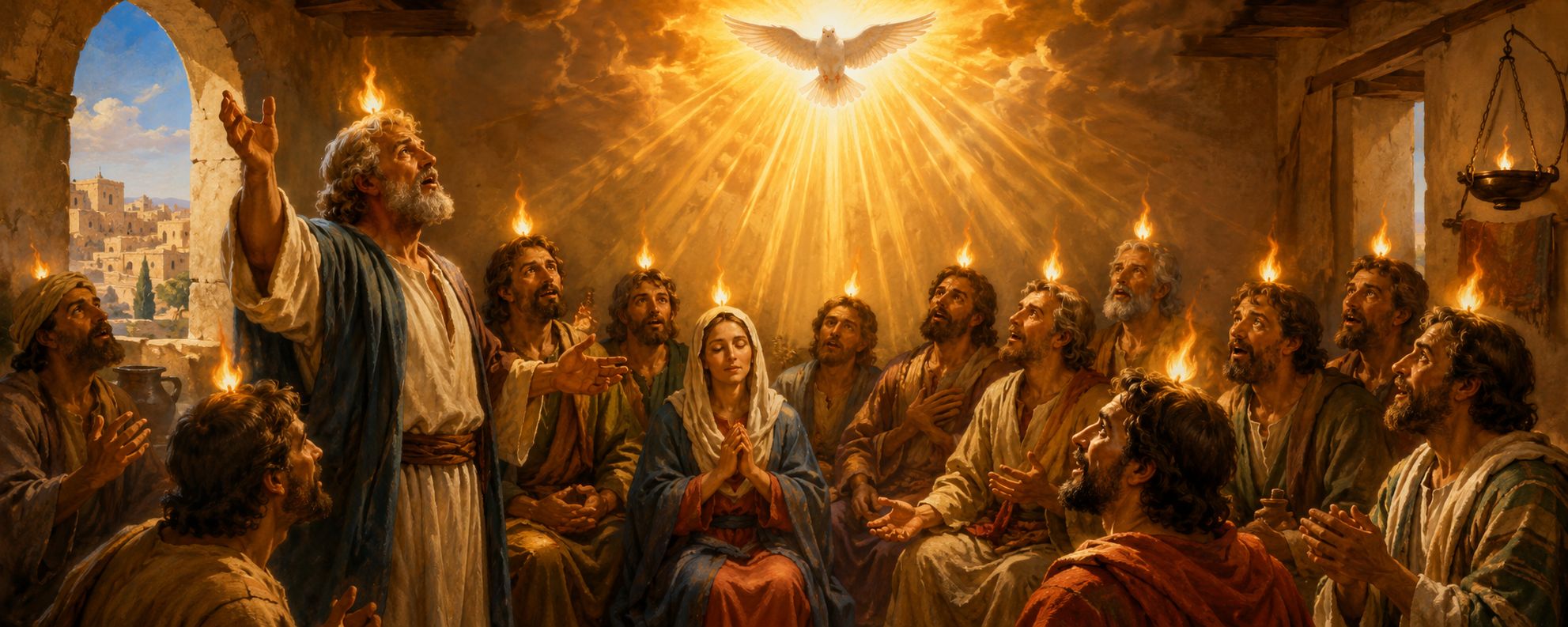
THEME: THE DESCENT OF THE HOLY SPIRIT
Readings: Acts 2:1–11; 1 Corinthians 12:3–7, 12–13; John 20:19–23
Pentecost Sunday 2026
Introduction
Today, the Church celebrates one of her greatest feasts: Pentecost—the descent of the Holy Spirit upon the Apostles.
Before Pentecost, the disciples were hiding behind locked doors, afraid and uncertain about the future. But after receiving the Holy Spirit, they emerged transformed — bold, joyful, united, and filled with divine power. Peter, who once denied Jesus, now preached fearlessly before crowds. The Apostles, who were once timid, became missionaries ready to suffer and even die for the Gospel.
The readings of today invite us to reflect deeply on the meaning of the Spirit’s coming and on our responsibility as Spirit-filled Christians.
1. The Significance of the Spirit’s Manifestation as Tongues of Fire
In the first reading from Acts, we hear that when the Holy Spirit descended upon the Apostles, “tongues, as of fire, appeared among them” (Acts 2:3).
Fire is a powerful biblical symbol. Throughout Scripture, fire represents the presence, power, holiness, and purification of God. He appeared to Moses in the burning bush. He guided Israel through the wilderness with a pillar of fire. At Mount Sinai, He descended in fire.
Thus, the tongues of fire at Pentecost signify that the Spirit of God had come to dwell in the disciples in a new and empowering way.
Fire gives light. The Holy Spirit enlightens our minds to understand God’s truth. Without the Spirit, we easily walk in darkness, confusion, and error.
Fire gives warmth. The Holy Spirit fills hearts with love — love for God and love for neighbour. A Christian without love is like cold ashes without fire.
Fire purifies. Gold is purified by fire, and so the Holy Spirit purifies us from sin, selfishness, pride, hatred, and spiritual lukewarmness.
Fire spreads. A single flame can burn a whole forest. The Holy Spirit was not given to the Apostles merely for personal holiness but for mission — to spread the Gospel to the ends of the earth.
It is also significant that the fire of Pentecost was in no other form than the form of tongues. This signifies the gifts of knowledge and eloquence to proclaim the Gospel.
So, the tongues of fire remind us that Pentecost was not simply an emotional experience; it was a divine empowerment for holiness, unity, and the mission of evangelization.
2. Each Disciple Received a Tongue of Fire – Some Gifts
An important detail in the first reading is that a tongue of fire rested on each of the disciples (cf. Acts 2:3). The Spirit did not descend only upon St. Peter or St. John or a selected few. Every disciple received the Spirit (cf. Acts 2:4).
This is profoundly significant. It means that every baptized Christian has received gifts from the Holy Spirit (cf. 1 Cor. 12:13). No one in the Church is spiritually empty or useless.
Thus, in the second reading, we are reminded that, the Spirit gives us a variety of gifts: “there are varieties of gifts, but the same Spirit” (1 Cor. 12:4; cf. verse 11). Some receive the gift of teaching; others leadership, healing, administration, music, encouragement, hospitality, wisdom, prayer, generosity, or service. Some have the gift of preaching publicly, while others quietly strengthen the Church through hidden sacrifices and intercessory prayer.
The Holy Spirit distributes gifts according to God’s wisdom and according to the needs of the Church. This means two things.
First, no one should feel inferior because his or her gifts differ from those of others. The hand cannot say to the eye, “I do not need you.” Every gift matters.
Second, no one should become proud because of his or her gifts. The gifts are not personal achievements; they are graces freely given by God.
The tragedy today is that many Christians either do not know their gifts or fail to use them. Some bury their talents because of fear, laziness, discouragement, or criticism from others.
Pentecost challenges us to rediscover the gifts the Holy Spirit has placed within us.
3. All Gifts Are Meant for the Building Up of the Church
St. Paul makes another crucial point: spiritual gifts are not given for selfish purposes. He says: “To each is given the manifestation of the Spirit for the common good” (1 Cor. 12:7). The Holy Spirit gives gifts for the good of the Church—the Body of Christ.
A gift that is not used for service loses its purpose. Just as organs in the body exist to serve the whole body, so every Christian gift exists to strengthen the Church community.
The choir sings not for applause but to lift souls to God. Catechists teach not for recognition but to form disciples. Priests minister not for power but for service. Parents nurture children not merely for society but for God’s Kingdom.
The Spirit creates unity amid diversity. At Pentecost, people from different nations heard the Apostles speaking in their own languages. The Spirit did not erase differences; rather, he united people through their differences.
This is the miracle of Pentecost: unity without uniformity. Unfortunately, in our world today, divisions are everywhere — tribalism, political polarization, ethnic conflicts, jealousy, and competition even within the Church. The Spirit comes to heal these divisions and to unite us into one Body in Christ.
Where the Spirit is present, there is reconciliation, cooperation, mutual respect, and communion.
Conclusion: How Are You Using Your Gifts for the Church’s Growth?
Beloved in Christ, Pentecost is not merely a historical event we remember once a year. It is an ongoing reality in the life of the Church. The same Spirit who descended upon the Apostles desires to descend upon us today — to enlighten our minds, inflame our hearts, purify our lives, and empower us for mission.
Let’s, then, ask ourselves some serious personal questions: What gifts has the Spirit given me? How am I using them? Am I contributing to the growth of the Church, or am I merely a passive spectator?
Beloved, may we never be Christians who hide behind locked doors of fear, indifference, or complacency. Instead, may we become courageous witnesses of Christ in our homes, workplaces, schools, and communities.
Finally, may each of us discover our gifts, develop them faithfully, and use them generously for the building up of the Church.
Come, Holy Spirit! Fill the hearts of your faithful and kindle in them the fire of your love. Amen.
By Most Rev. John Kobina Louis