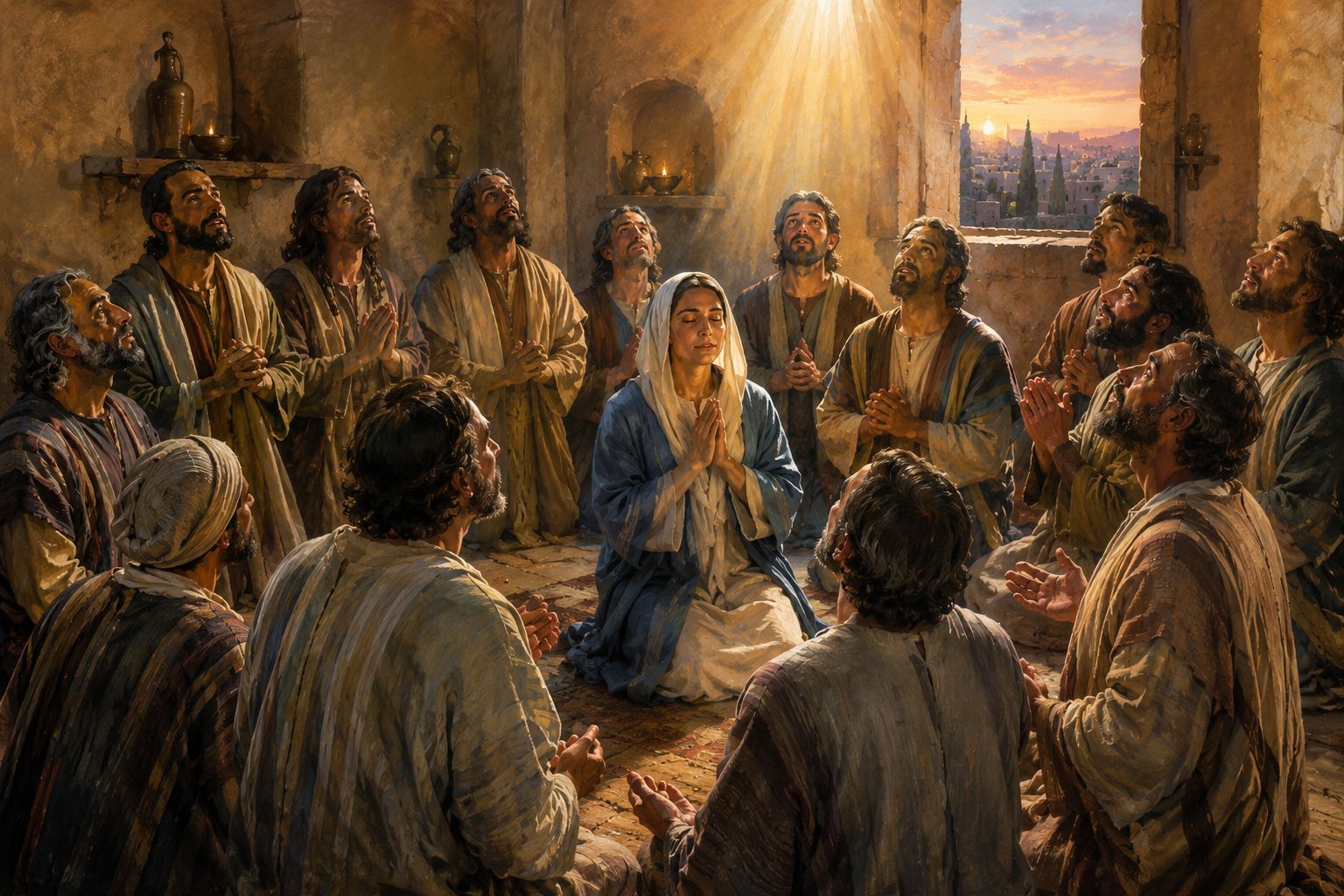
THEME: AWAITING THE HOLY SPIRIT IN THE UPPER ROOM
READINGS: Acts 1:12-14/ 1 Peter 4:13-16/ John 17:1-11
7th Sunday of Easter
Introduction
Beloved in Christ, today, the Church places us spiritually between two great events: the Ascension of the Lord and Pentecost. After the Ascension, the Apostles returned to Jerusalem, and together with other disciples, they gathered in the Upper Room (cf. Acts 1:12-14). The promised Holy Spirit was yet to descend upon them. So, it was a period of waiting, expectation, prayer, and hope in the Upper Room.
In many ways, dear people of God, we understand what it means to wait. We wait for jobs, for healing, for marriages, and for answers to many prayers. But today’s readings teach us that Christian waiting is never passive. It is active, faith-filled, prayerful, and communal. The disciples did not wait in despair; they waited with confidence in God’s promise.
As we prepare ourselves for Pentecost, let us reflect on how we too are awaiting the new outpouring of the Holy Spirit.
1. Awaiting the Spirit with Faith
According to today’s gospel reading, Jesus Christ prayed thus to His Father: “the words that you gave to me I have given to them [disciples], and they have received them and know in truth that I came from you; and they have believed that you sent me” (John 17:8). Thus, Christ alluded to the faith His disciples had in Him.
The disciples awaited the Spirit because they believed in the promise of Christ (cf. John 14:16). Faith sustained them while they waited.
The disciples did not know exactly how the Spirit would come, but they trusted Christ completely. Beloved, awaiting the Holy Spirit means refusing to give up on God even when circumstances seem difficult. Faith keeps the heart open to divine action.
2. Awaiting the Spirit with Prayer
Saint Luke tells us that the disciples “devoted themselves with one accord to prayer” (Acts 1:14). Before Pentecost came prayer. Before missionary activity came prayer. Before miracles came prayer. Prayer prepares the heart for the Holy Spirit.
Sometimes we desire the power of Pentecost without the discipline of prayer. We want spiritual strength, but we neglect Mass, personal prayer, Scripture reading, Eucharistic Adoration, and the Rosary.
In our busy life especially in the cities, many things compete for our attention: business pressures, traffic, social media, entertainment, and financial anxieties. Yet today’s readings remind us that those who pray with faith and sincerity experience the power of the Holy Spirit. As the on-switch connects a gadget to an electrical power, so prayer connects us to the invisible yet powerful movement of the Holy Spirit.
Our homes should become little Upper Rooms of prayer. Parents should pray with their children. Young people should learn to spend time with God. Parish groups and societies should not merely have meetings or organize activities but deepen prayer.
3. Awaiting the Spirit in Mother Mary’s Company
One beautiful detail in today’s first reading is the presence of the Blessed Virgin Mary among the disciples: “All these devoted themselves with one accord to prayer, together with Mary, the mother of Jesus.” (Acts 1:14)
Mother Mary, who overshadowed by the Holy Spirit conceived Jesus at the Annunciation, now waited prayerfully with the Church for a new outpouring of the same Spirit at Pentecost. She teaches us how to await the Holy Spirit — with humility, silence, obedience, and trust (cf. Luke 1:26-38).
In Ghanaian Catholic life, devotion to Mother Mary is deeply cherished. Our Rosaries, Marian processions, and devotions are not empty traditions. They are pathways that lead us closer to Christ and open our hearts to the Spirit. When we stay close to her, she teaches us how to listen to her Divine Son. She calms our anxieties and directs us toward Him (cf. John 2:5).
In a world filled with noise and confusion, Mother Mary teaches us interior silence (cf. Luke 2:19,51). In a culture sometimes marked by impatience, she teaches us faithful waiting. Let us never be ashamed of our Marian devotion. The Apostles themselves awaited Pentecost in her company.
4. Awaiting the Spirit in the Community of Believers
The disciples did not await the Spirit individually and separately. They gathered together as one community (cf. Acts 1:12-14). Pentecost was prepared with communal prayer and fellowship.
The Spirit who came at Pentecost united people of different languages and cultures into one Church (cf. Acts 2:1-5). Therefore, as Catholics, we must resist anything that destroys unity in our families, church groups, parishes, communities and nation.
As we prepare for the new outpouring of the Holy spirit, let us do away with divisive vices like bitterness, tribalism, gossip, hatred, jealousy, unforgiveness, etc.
In our parishes, we must support one another. We must pray for one another. We must welcome newcomers. We must care for the poor, the sick, and the struggling. A Spirit-filled Church is a united and compassionate Church.
Beloved, no one receives Pentecost alone. So, let us await the Spirit together.
Conclusion
As we journey toward Pentecost, the Word of God today invites us into the experience of the first disciples: waiting in hope, faith, prayer, unity and with Mother Mary.
Like the Apostles in the Upper Room, we too are waiting for a fresh outpouring of the Holy Spirit upon our lives, families, church, and nation.
Ghana today needs the Holy Spirit. We need the Spirit’s wisdom in leadership, honesty in public life, peace in our communities, strength in families, and faithfulness among Christians.
May this coming week become for each of us a spiritual Upper Room. Let us pray more fervently. May our faith be deepened. Let us stay close to Mother Mary. Let us strengthen unity in our families and church.
And when the Holy Spirit comes anew into our hearts, may He transform us from fearful believers into courageous witnesses of Christ.
Come, Holy Spirit! Amen.
By Most Rev. John Kobina Louis