HOMILY FOR THE CLOSING MASS OF THE PROVINCIAL CHAPTER
Brothers of St. John of God – Dodowa, Ghana (April 24, 2026)
Theme: “Expanding Hospitality in a Changing World”
Readings: Acts 9:1–20; John 6:52–59
Introduction
Dear Brothers in Christ,
As you bring this Provincial Chapter to a close, after days of prayer, discernment, dialogue, and fraternity, the Word of God offered to us today is not accidental—it is providential. It places before us two powerful movements: resistance and transformation; closure and expansion; misunderstanding and mission. These movements speak directly to your theme: “Expanding Hospitality in a Changing World.”
The Gospel presents a crowd that resists Jesus’ life-giving gift, while the first reading reveals Saul, who embraces conversion and becomes a vessel of mission. Between these two stands Ananias, a quiet but crucial instrument of God’s transforming hospitality. And all of these converge in the life and charism of your founder, whose conversion ignited a revolution of compassionate care.
1. The Unconverted Crowd Forfeit Jesus’ Offer of Eternal Life (John 6:52–59)
In the Gospel, we encounter a troubling scene. The people argue among themselves: “How can this man give us his flesh to eat?” Their reaction is not just confusion—it is resistance. They are unable to move beyond the literal, beyond their comfort zone, beyond their expectations of God.
Jesus offers them the Bread of Life—his very self—but they close themselves to the gift. The tragedy is not that the gift was unclear; the tragedy is that their hearts were unprepared. They preferred familiarity to transformation.
This is the danger of every age, including ours. In a rapidly changing world, there is a temptation to retreat into what is safe, known, and predictable. Yet hospitality, especially the kind your charism embodies, demands openness—openness to new expressions, new needs, new faces of suffering Christ.
When hearts are closed, even divine nourishment is rejected. But when hearts are open, even the most challenging invitation becomes a source of life.
2. Saul’s Radical Conversion Brings Him New Life and Expands the Mission of the Church (Acts 9:1–20)
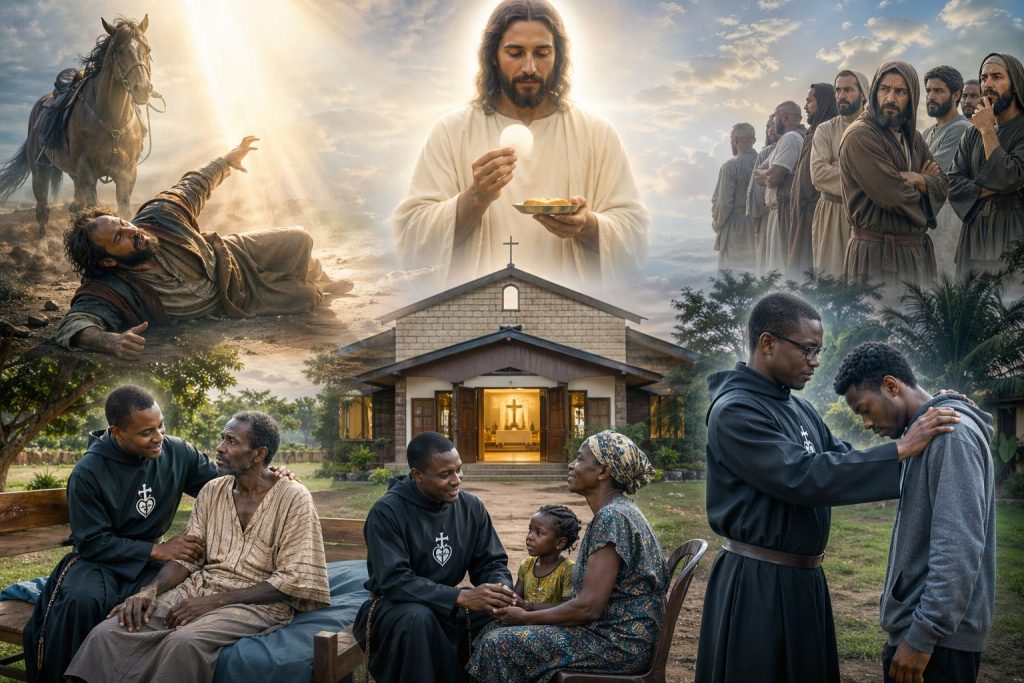
In stark contrast stands Saul. He begins as a man full of certainty—but dangerously misguided certainty. He is zealous, but his zeal is destructive. Yet, on the road to Damascus, he encounters Christ—and everything changes.
Struck down, blinded, humbled—Saul is emptied of himself so that he may be filled with Christ. His conversion is not superficial; it is radical. He moves from being a persecutor to becoming a proclaimer, from destroying the Church to building it.
And notice this: Saul’s conversion does not only change his life—it expands the mission of the Church. Through him, the Gospel reaches new territories, new peoples, new horizons.
Brothers, this is what authentic conversion does. It is never private. It always has a missionary consequence. When you are truly converted, your hospitality expands. Your capacity to welcome, to serve, to heal, to accompany—it all grows.
A Church—and a religious Order—that is not continually converted risks becoming like the crowd in the Gospel: present, but unresponsive; close, but not open.
3. Conversion is an Ongoing Process: the Example of Ananias (Acts 9)
Often, we focus on Saul, but today we must also reflect on Ananias. He receives a difficult command from the Lord: “Go to Saul.” And his initial reaction is hesitation—even fear. He knows Saul’s reputation.
Yet, Ananias undergoes his own conversion. He moves from fear to trust, from suspicion to acceptance. He goes to Saul, lays hands on him, calls him “Brother,” and becomes the instrument through which Saul regains sight and receives the Holy Spirit.
This is profound. Before Saul could become Paul, someone had to welcome him. Someone had to risk trust. Someone had to extend hospitality.
Ananias teaches us that conversion is not a one-time event; it is a continuous journey. Even the faithful must keep converting—especially in how they see others, especially in whom they are willing to welcome.
In a changing world, the “Sauls” of today may look different. They may be the marginalized, the mentally ill, the addicted, the abandoned, the misunderstood. The question is: do we see them as threats—or as brothers?
4. Conversion Was Key to St. John of God’s Expanding Hospitality
Your founder stands as a living synthesis of these readings. His life was marked by a dramatic conversion—one that reoriented his entire existence.
From a man searching for meaning, he became a man consumed by charity. His conversion opened his eyes to the suffering Christ in the sick, the poor, and the abandoned. And from that moment, his life became a radical expression of hospitality.
But his hospitality was not static. It expanded. It adapted. It responded to the needs of his time in creative and courageous ways.
This is the heart of your charism: hospitality that is dynamic, inclusive, and transformative. It is not merely about providing services; it is about offering presence, dignity, and love. It is about creating spaces where the rejected feel received, where the broken find healing, where the forgotten are remembered.
And all of this flows from a converted heart. So, as you conclude this Chapter, what is the Lord asking of you?
First, remain open to ongoing conversion. Do not allow familiarity with your mission to dull its urgency. Let the Word of God continually challenge and renew you.
Second, expand your understanding of hospitality. In a changing world, new forms of suffering are emerging—mental health crises, social isolation, migration, economic hardship. Your response must be equally dynamic and creative.
Conclusion
Dear Brothers,
The crowd in the Gospel walked away from the gift. Saul embraced it and was transformed. Ananias risked trust and became a bridge of grace. Your founder lived it and changed the world around him.
Now the choice is yours.
As you leave Dodowa, may you not return the same. May your hearts be more open, your vision more expansive, your charity more creative, and your commitment more courageous.
May your lives continue to proclaim, in word and deed, that in a changing world, the hospitality of Christ remains constant, healing, and transformative.
Amen.
By Most Rev. John Kobina Louis