THEME: THE EUCHARIST AND WASHING OF FEET BY CHRIST: SOME LESSONS FOR US TODAY
Readings: Exodus 12:1-8,11-14/ 1 Corinthians 11:23-26/ John 13:1-15
Holy Thursday, 2026
INTRODUCTION
Beloved in Christ, tonight, we enter into the mystery of Holy Thursday — a night of divine love, a night of total self-giving, a night of humble service. In the Upper Room on the eve of His Passion, our Lord Jesus gave us some of His great gifts: the Holy Eucharist (Mass), the priesthood, and the commandment of love expressed through humble service.
The readings of today lead us deeply into this mystery. In Exodus 12:1-8,11-14, we see the institution of the Passover of the Old Testament — the saving act of God for His people. In the second reading (1 Corinthians 11:23-26), we hear the solemn words of Jesus instituting the Eucharist. And in the gospel reading (John 13:1-15), we witness a powerful and surprising act: the Lord Jesus stooping down to wash the feet of His disciples. These are not just past events—they are living realities that challenge us today.
1. THE EUCHARIST: A GIFT OF TOTAL SELF-GIVING
At the Last Supper, Jesus took bread and wine and transubstantiated them into His Body and Blood, saying: “This is my body… This cup is the new covenant in my blood” (1 Corinthians 11:23–26).
The Eucharist is the powerful expression of love—Jesus giving Himself completely for our salvation. He becomes our food so that we may have life.
In the first reading, the Passover lamb was sacrificed, and its blood became a sign of deliverance (Exodus 12). Jesus now becomes the new Passover Lamb, whose sacrifice brings eternal salvation.
For us today, the Eucharist is not just something we attend — it is Christ Himself we receive. Each time we attend Holy Mass, we are invited into a relationship of deep communion with Christ.
The question is: Do we recognize the greatness of this gift? And does it transform the way we live?
2. THE WASHING OF FEET: A LESSON IN HUMBLE SERVICE
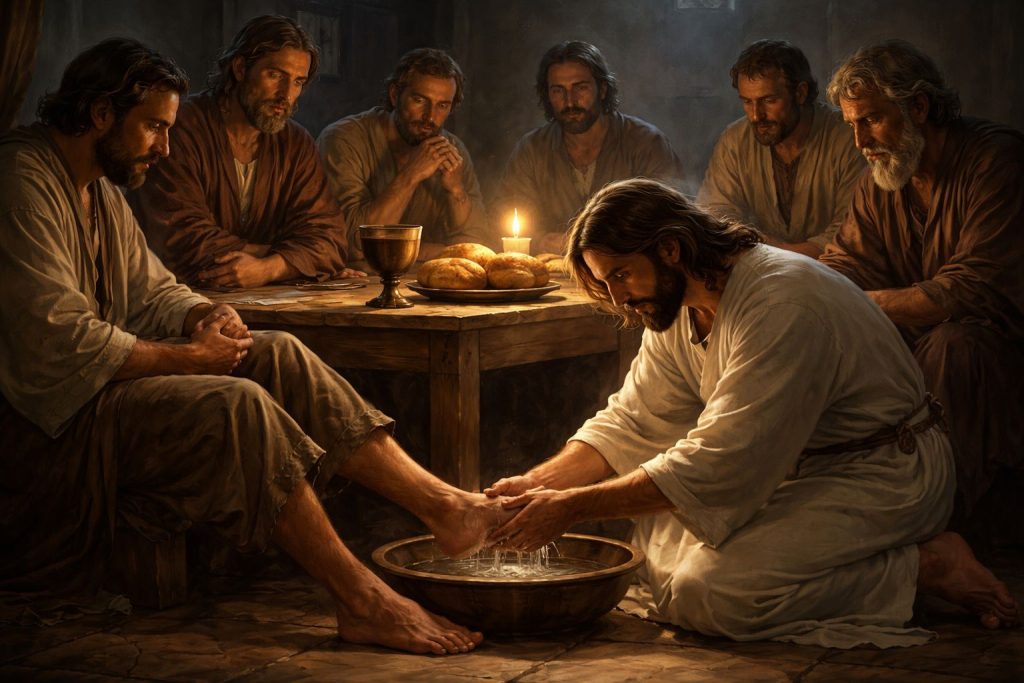
In a striking gesture, Jesus arose from the table, removed His outer garment, knelt down, and washed the feet of His disciples (John 13:1-15). This act was shocking. Washing feet was the work of a servant — yet the Master washed the feet of His servants.
Jesus is teaching us that love must be expressed in action. It is not enough to speak about love; we must live it through service. In our Ghanaian communities — where respect, hierarchy, and honour are important — Jesus challenges us to rethink greatness. True greatness lies not in being served, but in serving others.
3. THE EUCHARIST AND SERVICE ARE INSEPARABLE
It is no coincidence that these two actions—the institution of the Eucharist and the washing of feet—happened at the same meal. They belong together.
The Eucharist we receive must lead us to service. If we truly partake in the Body of Christ, we must become the hands and feet of Christ in the world.
We cannot receive Holy Communion and remain indifferent to the suffering of others. We cannot say “Amen” at the altar and say “no” to our neighbour in need.
The Eucharist sends us on a mission — to love as Christ loves.
4. A CALL TO SACRIFICIAL LOVE
The Passover meal in Exodus required sacrifice — the lamb had to be slain. Likewise, the Eucharist is rooted in sacrifice — the sacrifice of Christ on the Cross.
True love always costs something. Jesus knew that Judas would betray Him, Peter would deny Him, and the others would flee—yet He still gave Himself completely. This is the love we are called to imitate:
- Love that forgives even when hurt
- Love that gives even when it is inconvenient
- Love that endures even when it is difficult
In our families, marriages, parishes and communities, this sacrificial love is urgently needed. Without sacrifice, love becomes shallow. With sacrifice, love becomes transformative.
5. A CALL TO COMPASSIONATE AND INCLUSIVE SERVICE
Jesus washed the feet of all His disciples — not just the good ones, not just the faithful ones, but everyone including Judas. This teaches us that Christian service must be inclusive and compassionate. We are called to serve:
- The poor and marginalized
- The sick and elderly
- The lonely and forgotten
- Even those who have hurt us
In Ghana today, where many struggle with economic hardship, unemployment and social challenges, the Church must be a place of compassion and active care. So, each Church member is called to be a sign of Christ’s compassion in the world.
CONCLUSION
Beloved in Christ, Holy Thursday is not just a remembrance — it is a call to transformation. As we celebrate the Eucharist and witness the washing of feet tonight, may we learn from Christ:
- To give ourselves completely
- To serve humbly
- To love sacrificially
- To act with compassion
When we receive the Body and Blood of Christ, we become what we receive. We become Christ for others. May our lives reflect the mystery we celebrate tonight, so that in our homes, our parishes, and our nation, the love of Christ may be seen, felt, and experienced.
Amen.
By Most Rev. John Kobina Louis