Theme: Saints Perpetua and Felicity: Models of New Life in Christ
Homily of Holy Mass at the National Conference of the Inter-Tertiary Institutions Catholic Charismatic Renewal, at Catholic Chaplaincy of the University of Ghana, on March 7, 2026
Readings: Micah 7:14-15,18-20 and Luke 15:1-3,11-32
INTRODUCTION
Dear brothers and sisters in Christ, our conference theme is “New Life in Christ” (cf. 2 Corinthians 5:17; Colossians 1:15–20). Today, as the Church commemorates Saints Perpetua and Felicity, we see this theme not as an abstract idea but as a lived reality—costly, courageous, and radiant.
Saints Perpetua (died: 22 years) and Felicity (died: 21 years) stand before us today as powerful witnesses that this new life is real.
1. SOME KEY FEATURES OF NEW LIFE IN CHRIST
From today’s Gospel reading (Luke 15:1–3, 11–32) and our conference theme, we can identify several key features of New Life in Christ:
(a) It Is a Life of Conversion
The prodigal son “came to his senses.” New life begins when we recognize our need for the heavenly Father. It begins with humility.
Many young people today live in a “far country”—a country of distraction, addiction, moral confusion, spiritual indifference. But new life begins when you take the bold decision and arise to return to our heavenly Father.
(b) It Is Rooted in Identity
Saint Paul says: “If anyone is in Christ, he is a new creation” (2 Cor 5:17).
And in Colossians, Christ is revealed as the image of the invisible God, the one in whom all things hold together.
New life means knowing who you are:
Not a failure.
Not a statistic.
Not defined by your past.
You are a son. You are a daughter.
The prodigal son returned expecting to be a servant—but the Father restored him as a son.
(c) It Is Sustained by Communion with the Father
The younger son found life only when he returned home.
The elder son, though physically at home, lacked the joy of communion.
New life is not simply being in church physically. It is living in relationship with the Father—daily prayer, sacraments, obedience, community.
(d) It Is a Life Stronger Than Death
Perpetua and Felicity show us that new life in Christ is stronger than persecution, fear, and even death itself.
When the world sees defeat, God reveals victory.
2. ST. PERPETUA AS A MODEL FOR YOUNG CATHOLICS TODAY
Perpetua was a young noblewoman, well-educated, newly married, and a nursing mother. She had everything to live for—status, family, comfort.
Yet when persecution broke out in Carthage (Tunisia) around 203 AD, she chose Christ.
Her father pleaded with her: “Think of your baby! Think of your family!”
But Perpetua responded with clarity and courage. Pointing to a vessel, she said: “Can it be called by any other name than what it is?” “No.”
“So too I cannot be called anything other than what I am—a Christian.”
What does this teach our young Catholics?
(a) She Lived Her Identity Boldly
Perpetua did not hide her faith to protect her future.
She did not dilute her convictions to fit society.
Young people, on your campuses, do not be ashamed of Christ.
In lecture halls, hostels, laboratories, social media—be Christians not only in name but in truth.
(b) She Chose Eternal Life Over Temporary Security
The prodigal son left home seeking pleasure and lost everything.
Perpetua, however, gave up earthly security and gained eternal glory.
She understood something powerful:
This world is not the final destination.
(c) She Was Spiritually Deep
While imprisoned, Perpetua had visions of heaven. Her interior life was strong. She was not spiritually shallow.
New life in Christ demands depth—prayer, Scripture, Eucharistic devotion, openness to the Holy Spirit.
Charismatic youth, your gifts must be rooted in holiness.
Power without holiness is noise.
But power rooted in holiness changes history.
3. ST. FELICITY AS A MODEL FOR YOUNG CATHOLICS TODAY
Now we turn to Felicity.
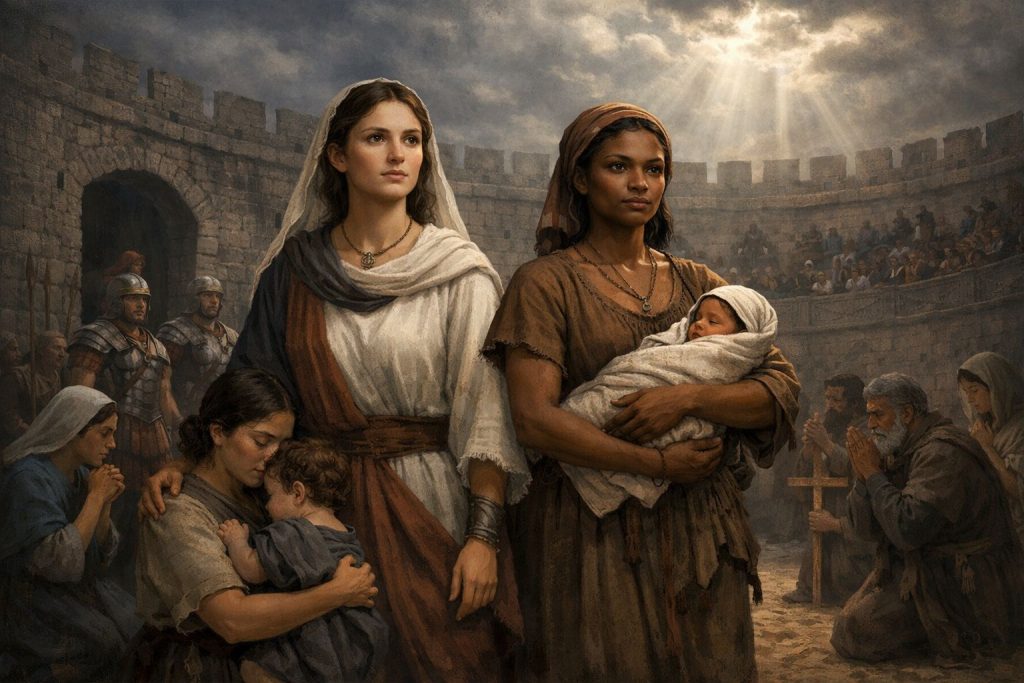
St. Felicity was a slave in the household of St. Perpetua. She was pregnant when imprisoned. Socially insignificant. Economically powerless.
Yet in Christ, she possessed a dignity greater than empires.
(a) She Lived the Equality of New Life in Christ
In ancient Roman society, Perpetua and Felicity were unequal—one noble, one slave.
But in Christ, they were equal – Sisters.
Colossians tells us Christ reconciles all things to Himself.
New life destroys the walls of class, tribe, status.
In our universities, divisions abound—faculty vs. faculty, tribe vs. tribe, rich vs. poor.
But in Christ, we are one body.
(b) She Endured Suffering with Hope
Felicity gave birth in prison days before execution. Guards mocked her pain:
“If you cry now, what will you do in the arena?”
She replied: “Now I suffer alone. But there Another will be in me who will suffer for me, because I will suffer for Him.”
That is new life in Christ—Christ living in you.
Felicity suffered united to Christ.
(c) She Witnessed Joy in the Face of Death
Historical accounts tell us they entered the arena with serenity.
Why? Because they had already passed from death to life in Christ.
When you truly live in Christ, fear loses its power.
CONCLUSION
Beloved young ones in Christ,
The father in today’s Gospel declares:
“This son of mine was dead and has come back to life.”
That is our story.
That is the Church’s story.
That is the story of Perpetua and Felicity.
They were not superheroes.
They were young ladies.
Students of life.
Mothers. Friends. Ordinary believers.
But they encountered Christ—and that encounter changed everything.
As you continue this conference here at the University of Ghana, ask yourselves:
- Have I truly returned to the Father?
- Am I living as a new creation?
- Does my campus see Christ alive in me?
May Saints Perpetua and Felicity intercede for us.
May they teach us courage without compromise.
May they show us joy stronger than suffering.
May they help us live and proclaim boldly: “I am a Catholic, a true Christian!”
And when the world sees us, may it say: “They were dead—but now they are alive in Christ.”
Amen.
By Most Rev. John Kobina Louis