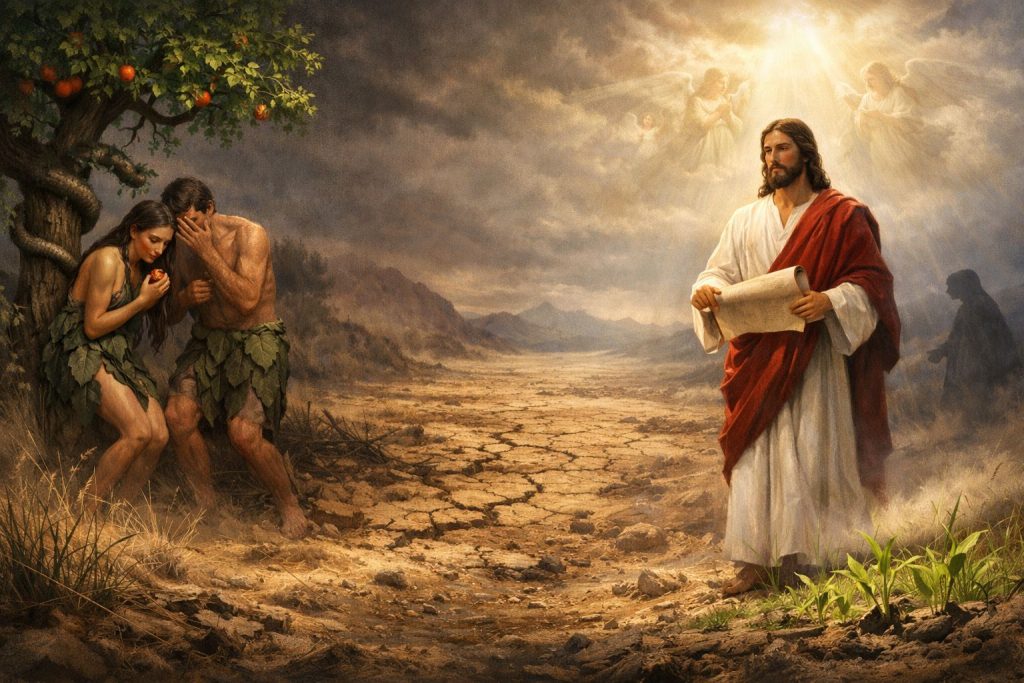
THEME: REVERSING THE FALL “FROM GRACE TO GRASS”
READINGS: Genesis 2:7-9; 3:1-7/ Romans 5:12-19/ Matthew 4:1-11
1st Sunday of Lent, 2026
1. INTRODUCTION
Beloved in Christ, on this First Sunday of Lent, the Church invites us to reflect on a most powerful movement in the history of humanity: the reversal of the movement “from grace to grass”.
Through disobedience, Adam and Eve fell to “grass” from the grace of intimate fellowship with God in the Garden of Eden (cf. Gen 3:1-7). But the Good News is this: what was lost in Adam and Eve is restored in Jesus Christ (cf. Rom 5:12-19). Jesus reverses the tragic movement “from grace to grass” and opens for us the path back to life.
2. ADAM AND EVE’S FALL: FROM GRACE TO GRASS
2.1 Life in the Garden as Grace
In the Book of Genesis, we see Adam and Eve placed in the Garden of Eden — a place of beauty, harmony, peace, abundance, joy and extraordinary closeness to God. They lived in grace:
- They enjoyed friendship with God
- They experienced harmony within themselves
- They lived in unity with each other
- They were at peace with creation
- They lacked nothing.
They were not merely alive; they were fully alive in grace. This is what grace means: sharing in the life of God.
2.2 The Temptation
Then comes the tempter. In Genesis 3, the serpent plants doubt in Eve: “Did God really say… You shall not eat the fruit of the tree or even touch it, lest you die?”
“You will not die. Rather, you will be like God.”
So, temptation begins by distorting God’s Word. It seductively suggests:
- God is withholding something from us
- Obeying Him limits our freedom
- Our fulfillment lies outside God’s will.
Doubting God’s goodness and distrusting His Word eventually lead to disobedience of His command.
2.3 The Fall
Eve sees that the fruit is good, pleasing, desirable. She takes and eats it. She then gives some to Adam who also eats it.
At that moment, grace is lost. The first sin was not simply eating fruit; it was choosing self over God, autonomy over obedience, pride over trust.
2.4 The “Grass” Experience: Consequences of the Fall
“Dust you are, and to dust you shall return” (Gen 3:19). They who were lifted from dust (cf. Gen 2:7) to “grace” return symbolically to “grass” — to frailty, suffering, toil, and death. The consequences include:
- Shame instead of innocence – Their eyes are opened to see their shame
- Fear instead of intimacy – They hide from God
- Blame instead of unity
- Death instead of life.
This is the human condition apart from grace: striving, sweating, dying — like grass that withers. This is the story of humanity. This is our story.
3. REVERSAL OF THE FALL BY JESUS CHRIST
Where Adam failed, Christ triumphs. Where humanity fell, Jesus stands firm.
3.1 Life in the Wilderness: The “Grass”
Unlike Adam, who lived in a lush garden, Jesus begins in the wilderness — a place of hunger, dryness, and testing. The wilderness represents our “grass stage”: weakness, vulnerability, dependence and mortality.
Jesus enters fully into our condition. He stands where fallen humanity stands.
Yet unlike Adam, He does not begin in privilege but in deprivation. He fasts for forty days. He is hungry. And there, the tempter comes.
3.2 The Temptations
The devil tempts Jesus three times:
- Turn stones into bread – satisfy yourself without trusting the Father
- Throw yourself down – test God’s protection
- Worship me – take glory without the Cross.
Notice how similar this is to Eden’s: Physical appetite; desire for proof and security; and desire for power and glory. The battlefield is the same: trust and obedience.
3.3 Overcoming Temptation by Obedience to God’s Word
Each time, Jesus responds not with argument, but with Scripture: “It is written…”
Where Adam doubted God’s Word, Jesus clings to it. Where Adam succumbed to the tempter, Jesus trusts His Father. Where Adam disobeyed, Jesus obeys.
Jesus refuses to turn stones into bread because “man shall not live by bread alone.” He refuses to test God. He refuses false glory. As Paul the Apostle says, through the obedience of one man, many are made righteous (cf. Rom 5:19). Jesus’ obedience is the turning point of history.
3.4 The Glory That Follows: The “Grace”
After the temptations, angels minister to Jesus. But beyond that moment lies the greater glory: His resurrection after His crucifixion; His glorious ascension; and the restoration of humanity.
Jesus moves from wilderness to glory. From hunger to fulfillment. From obedience unto death to glorious exaltation. He reverses the fall. Where Adam brought humanity from grace to grass, Jesus brings humanity from grass back to grace.
4. CONCLUSION
Beloved, Lent is our wilderness. We recognize our “grass” condition: our weaknesses, sins and mortality. But Lent is not about staying in the dust. It is about rising again. We are not condemned to remain “grass”. In Christ and through repentance, prayer, fasting, charity and obedience to God’s Word, we begin the journey back to “grace”.
Adam succumbed and fell. Christ trusted and rose. The question of Lent is this: Whom will we follow? May this holy season help us cling to God’s Word, resist temptation, and walk the path of obedience — so that in Christ, we may move from grass back to grace, and share in the glory that never fades.
Amen.
By Most Rev. John Kobina Louis