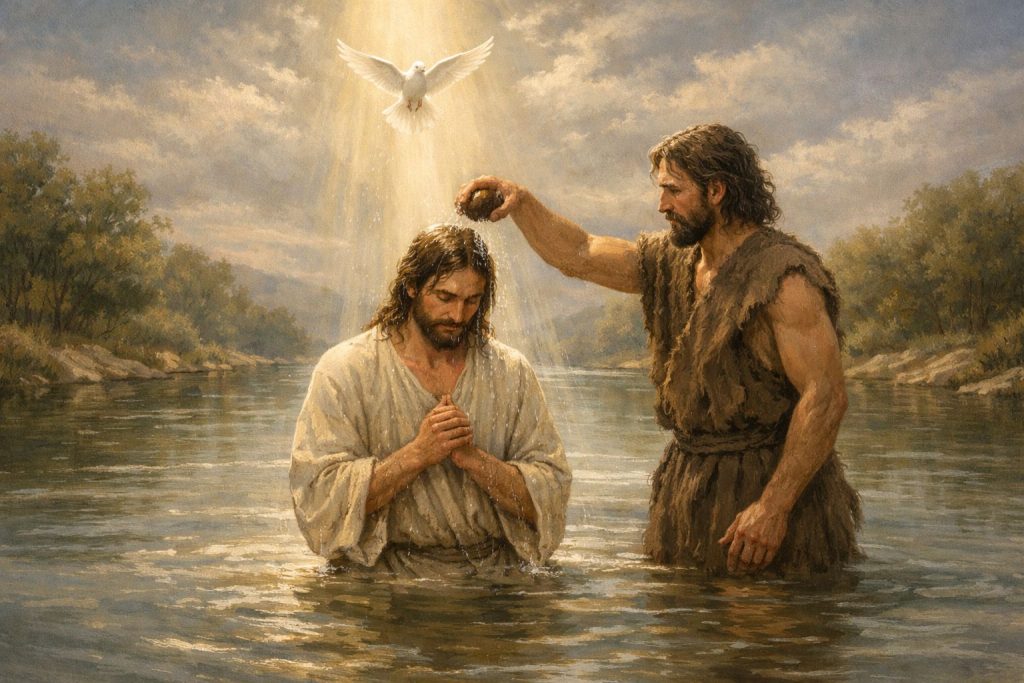
THEME: SOME LESSONS FROM THE BAPTISM OF OUR LORD
READINGS: Isaiah 42:1–4, 6–7/ Acts 10:34–38/ Matthew 3:13–17
Feast of the Baptism of the Lord Jesus Christ
Introduction
The Feast of the Baptism of the Lord Jesus Christ brings the Christmas season to a close and opens the door to His public ministry. In today’s readings, we are reminded not only of a spectacular event in which God reveals who Jesus is, but also what it means to follow Him. The lessons unfold in a beautiful sequence: humility before God, seeking God’s will, being anointed by the Holy Spirit, and living under the assurance of God’s approval.
1. Humility: The Way God Begins His Work
The Gospel immediately confronts us with a striking scene. Jesus, the sinless Son of God, steps into the waters of the Jordan to be baptized by St. John the Baptist — a baptism meant for repentance. John himself is confused and resists: “I need to be baptized by you” (Matt. 3:14). Yet Jesus insists.
Here we see the humility of Jesus. He does not stand apart from humanity; He stands with us. He enters the water where sinners stand, showing us that true greatness in God’s kingdom begins with humility. Isaiah had foretold this kind of servant: “Here is my servant whom I uphold… He will not cry out, nor shout” (Isa. 42:1-2). God’s chosen one comes gently, humbly, quietly faithful.
For us, this is the first lesson: God works most powerfully in hearts that are humble. If we want to encounter God, we must first step down from pride, self-sufficiency, and the false sense of control over our destiny.
2. Seeking and Submitting to God’s Will
Jesus explains His action to John the Baptist with one short sentence: “Allow it now, for thus it is fitting for us to fulfill all righteousness” (Matt. 3:15). In other words, this is the Father’s will.
Jesus’ baptism is not about personal need; for He is sinless. Rather, His baptism is about obedience to the Father’s will. So, from the very beginning of His ministry, Jesus shows us that a life pleasing to God is a life aligned with God’s will. He does not ask what is comfortable or impressive—He asks what the Father desires.
This challenges us deeply. How often do we seek God’s will only after we have decided what we want? Jesus shows us another way: trustful surrender. Baptism for us, too, is meant to be the starting point of a life that continually asks, “Lord, what do you want of me?”
3. Anointed by the Holy Spirit for Mission
Once Jesus humbly submits to the Father’s will, heaven responds. The Spirit of God descends upon Him like a dove (cf. Matt. 3:16). This moment fulfills Isaiah’s prophecy: “I have put my spirit upon him; he will bring forth justice to the nations” (Isa. 42:1).
In the Acts of the Apostles, St. Peter later reflects on this moment and declares that “God anointed Jesus of Nazareth with the Holy Spirit and power” (Acts 10:38). The Lord’s baptism marks His anointing for mission. Empowered by the Spirit, He goes forth to heal, to liberate, to bring light to those in darkness (cf. Isa. 42:6-7).
This teaches us an essential truth: God does not send us without equipping us. Through our own baptism and confirmation, we too receive the Holy Spirit. We are anointed—not for comfort, but for mission. We are sent to be instruments by which our Lord brings healing, justice, and hope in our families, workplaces, and communities.
4. Living in the Assurance of God’s Approval
The most awesome moment of the Gospel unfolds. The heavens open, and the Father’s voice is heard: “This is my beloved Son, with whom I am well pleased” (Matt. 3:17). This confirms what Isaiah had foretold: “My chosen one with whom I am pleased” (Isa. 42:1).
Thus, before Jesus performs a single miracle, before He preaches a sermon or heals a wound, the Father declares His love and approval. This is crucial. God’s approval does not come because of achievement; it comes from relationship. Jesus knows who He is—beloved Son—and from that identity flows everything else.
This is also God’s word to us. In baptism, He claims us as His beloved sons and daughters. When we live humbly, seek His will, and allow the Spirit to guide us, we can rest in the assurance that our lives give glory to God—not because we are perfect, but because we belong to Him.
Conclusion
The baptism of the Lord is not just a story about Jesus; it is a mirror for our own lives. We are invited to walk the same path: humility before God, obedience to His will, openness to the Holy Spirit, and confidence in the Father’s love.
As we remember our own baptism today, may we renew our commitment to live as God’s beloved children—anointed, sent, and sustained by His grace. Amen!
By Most Rev. John Kobina Louis